A bill that only grows
Capacity charges, software licences and hardware renewals rise with your workload, year after year, whether the business grows or not.
Mainframe modernization · COBOL to Java 21
Cobol2j turns your COBOL, CICS and JCL into readable Java 21 that runs on your own Kubernetes. Your VSAM data crosses over byte for byte, the screens and nightly batch keep working the way the business knows them, and nobody holds the keys to your code afterwards.
Why now
Capacity charges, software licences and hardware renewals rise with your workload, year after year, whether the business grows or not.
The people who know your COBOL and CICS are retiring faster than they can be replaced. Every change waits on a smaller team.
Big-bang rewrites reshape the data, take years and stall halfway. Emulators move the same problem to new hardware and keep you locked in.
Why Cobol2j
VSAM keeps its exact bytes inside PostgreSQL, packed decimal and all. There is no conversion project hidden inside the migration, and no month spent reconciling totals. Your analysts read the same records with plain SQL.
When a program passes your tests you certify it, and it becomes ordinary Java 21 in your Maven build and your IDE. You are not renting access to your own source code for the life of the system.
Whatever cannot be translated automatically is reported program by program before anyone signs a plan. The same engine does the assessment and the migration, so the estimate cannot drift from the result.
How it works
Every project follows the same sequence. Each step ends with something you can put in front of a steering committee.
An inventory, a dependency map and a program-by-program reading of what translates clean.
COBOL, CICS, JCL and embedded SQL become imperative Java 21 with your own names.
Online regions, job queue, spool and operator console on your Kubernetes.
When a program passes your tests, you certify it and the tool hands it over.
New services reach the same data with SQL and Spring Data.
Proof
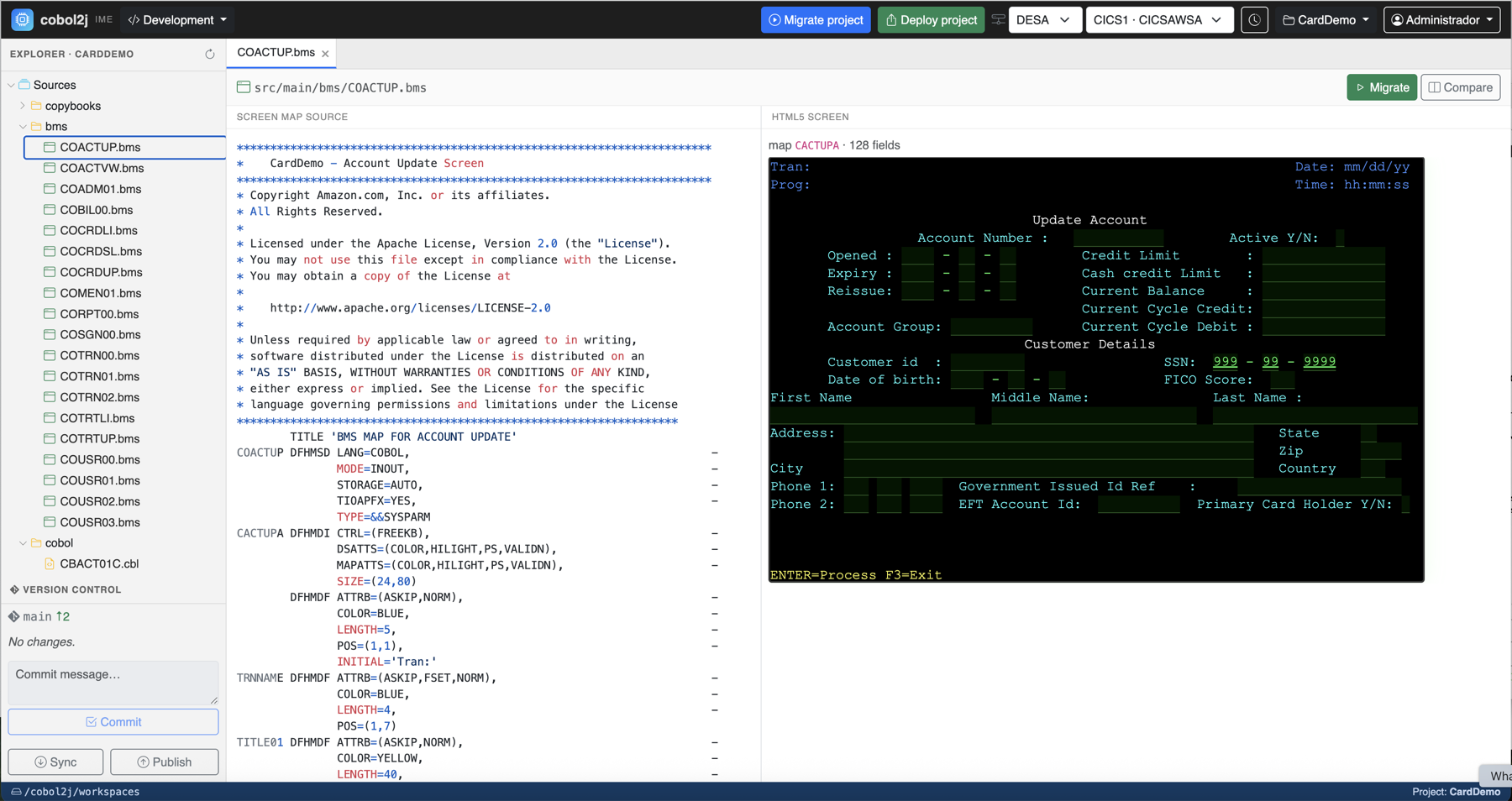
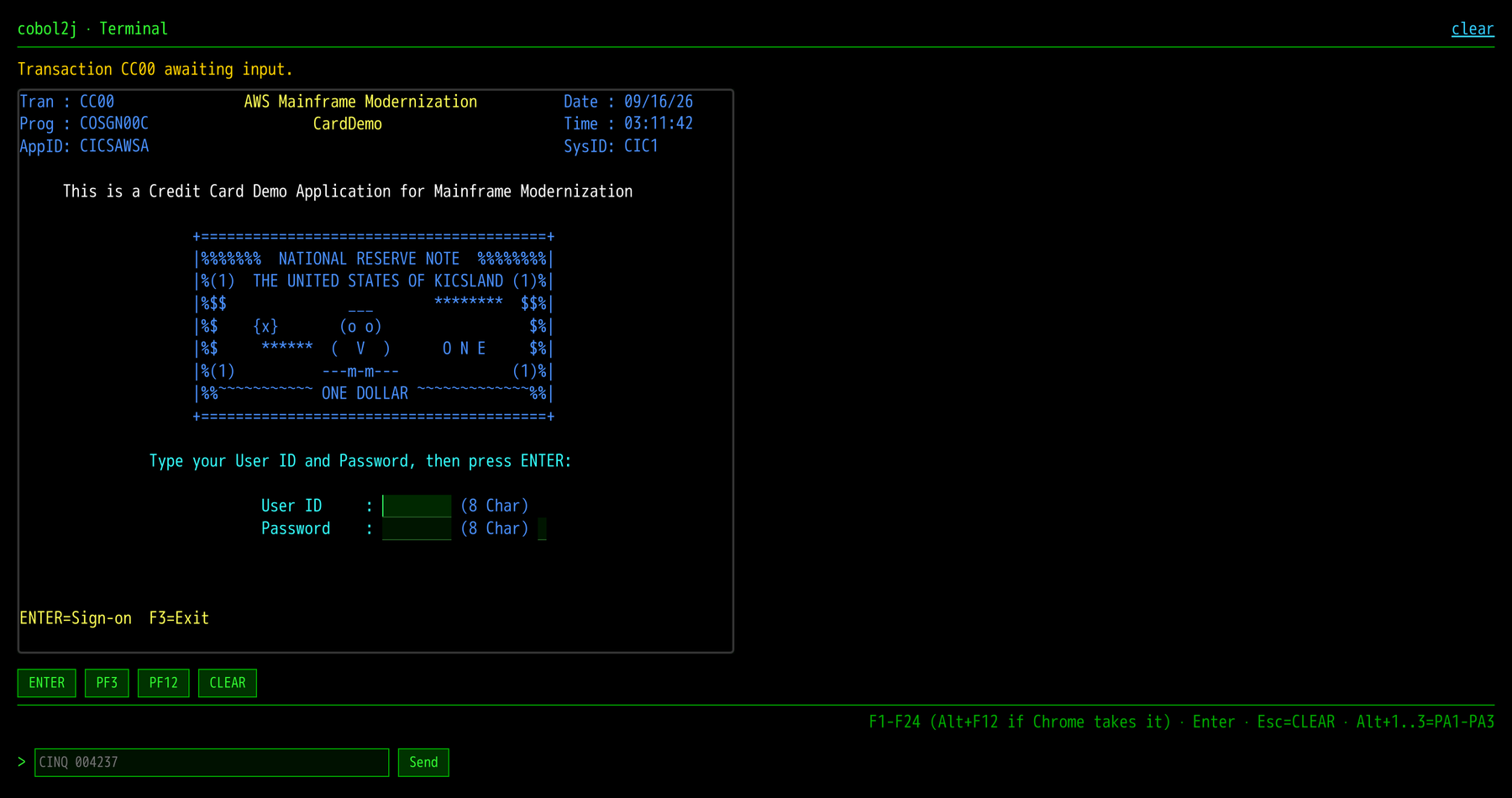
CardDemo is the public credit-card reference application of the mainframe world: CICS screens, VSAM files, BMS maps and nightly batch. We migrated it end to end and put it to work, so you can see the result before you share a single line of your own code.
The options
| Cobol2j | Emulation rehost | Manual rewrite | |
|---|---|---|---|
| What you end up with | Readable Java 21 your team maintains | Your COBOL, on a new runtime | New code, years from now |
| Your data | VSAM byte for byte, readable with SQL | Usually unchanged | Remodelled: a conversion project |
| Screens and batch | Same maps, same jobs, same operations | Same | Redesigned and retrained |
| After the project | No per-MIPS charge, no tool lock-in | Ongoing runtime dependency | A new system to stabilise |
| Risk known up front | Program by program, before you commit | Partly | Rarely |
Who it is for
Core accounts, cards and payments in CICS and batch.
Policy, claims and billing portfolios built over decades.
Eligibility, claims and records that run every night.
Integrators who want a product they can deliver with their own team.
Questions
No. The assessment is a single signed download that you run where the code already lives: no build tool, no credentials, no AI and no network connection. The migration itself runs on your cluster.
No. The migrated programs keep their CICS maps and their JCL. Screens come up in a 3270 terminal in the browser, and operators submit jobs to a queue and read the spool the way they do today.
VSAM files are loaded into PostgreSQL with their exact bytes: packed decimal, redefines and collation included. Nothing is remodelled, and the same records can be read with standard SQL.
Not for your code. Once a program is certified it is ordinary Java in your build, and the tool never regenerates it. You change it like any other Java.
On your Kubernetes, in your cloud or your datacenter. The licence is proprietary and there is no charge per MIPS or per transaction.
IMS is outside the standard scope. If your portfolio includes it, tell us up front and we will scope it with you.
With an assessment of your portfolio, then a measured pilot on a slice of your own programs, with a clear scope and price.
Send us a note about your portfolio. We will set up the assessment with your team.