Assessment
Know the portfolio before you commit to it
Send the source as it arrives and get back an inventory, a dependency map and a program-by-program reading of what translates clean. It is the same engine that performs the migration, so the estimate is not an opinion — and a committee can run it again next week and get the same answer.
- What is there and what is missing: programs, copybooks, screens and jobs, with the gaps named — a copybook nobody has, a screen with no program behind it, a utility the runtime does not run. You learn this in the first week rather than in month four.
- How it holds together: call, copy, file and job graphs. The order of a phased migration comes out of the code instead of a workshop, and the pilot can be scoped to a slice that actually stands on its own.
- Two reports from one run — a short pack for the committee and a detailed one for the architects, in Markdown, HTML and PDF — so the same facts reach the people who approve the budget and the people who have to live with it.
- Your source never leaves. It is a single signed download that you run where the code already lives — no build tool, no credentials, no AI, and not one network connection. The security review is one sentence long, so nobody has to ask legal for permission to get an estimate.
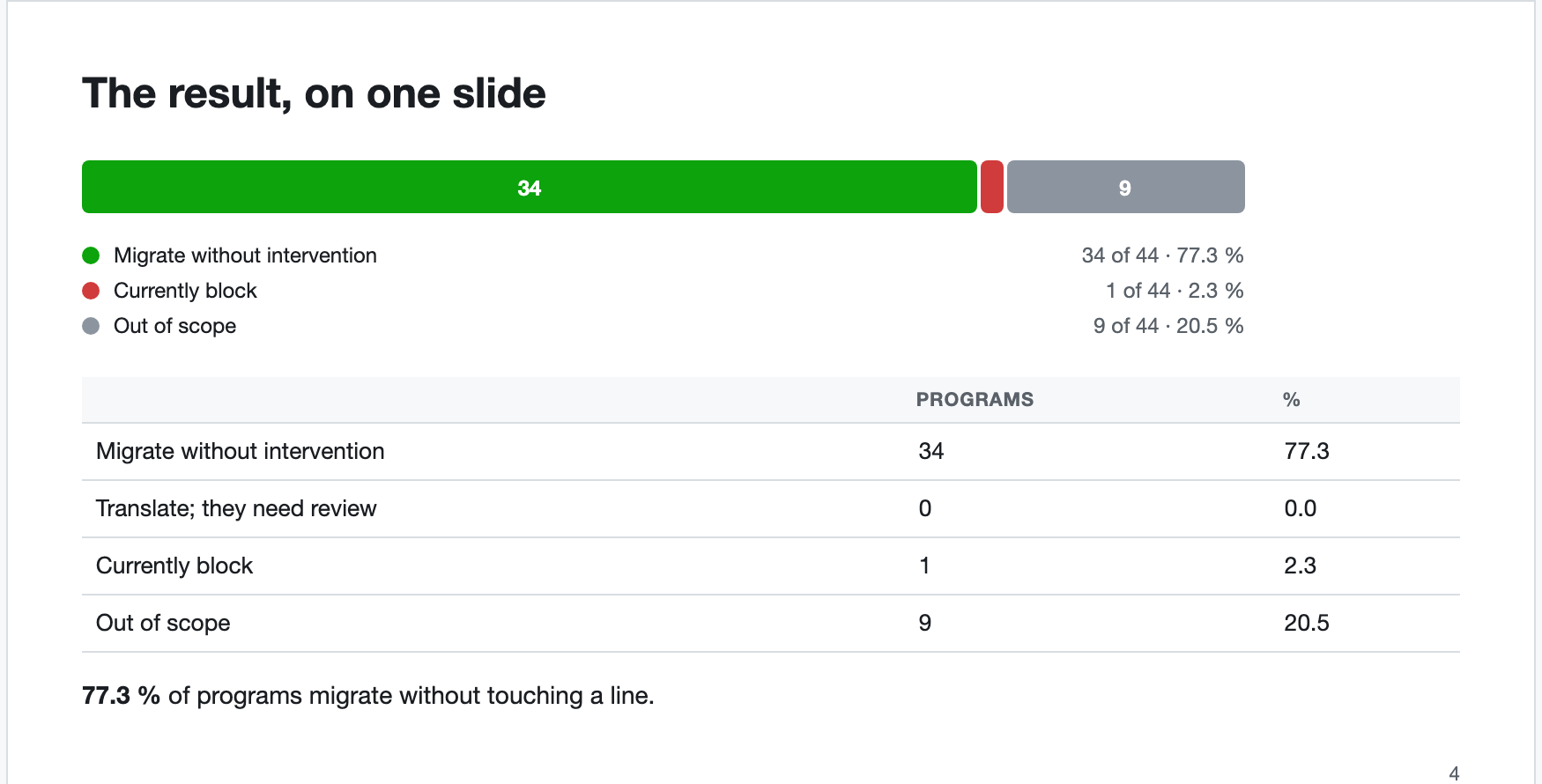
What it measures is how much of the portfolio translates — not that a run on your z/OS and a run here produce identical output. That comparison is the pilot’s job, on your data, and it is the honest place to prove it.